
 Dallas, Texas


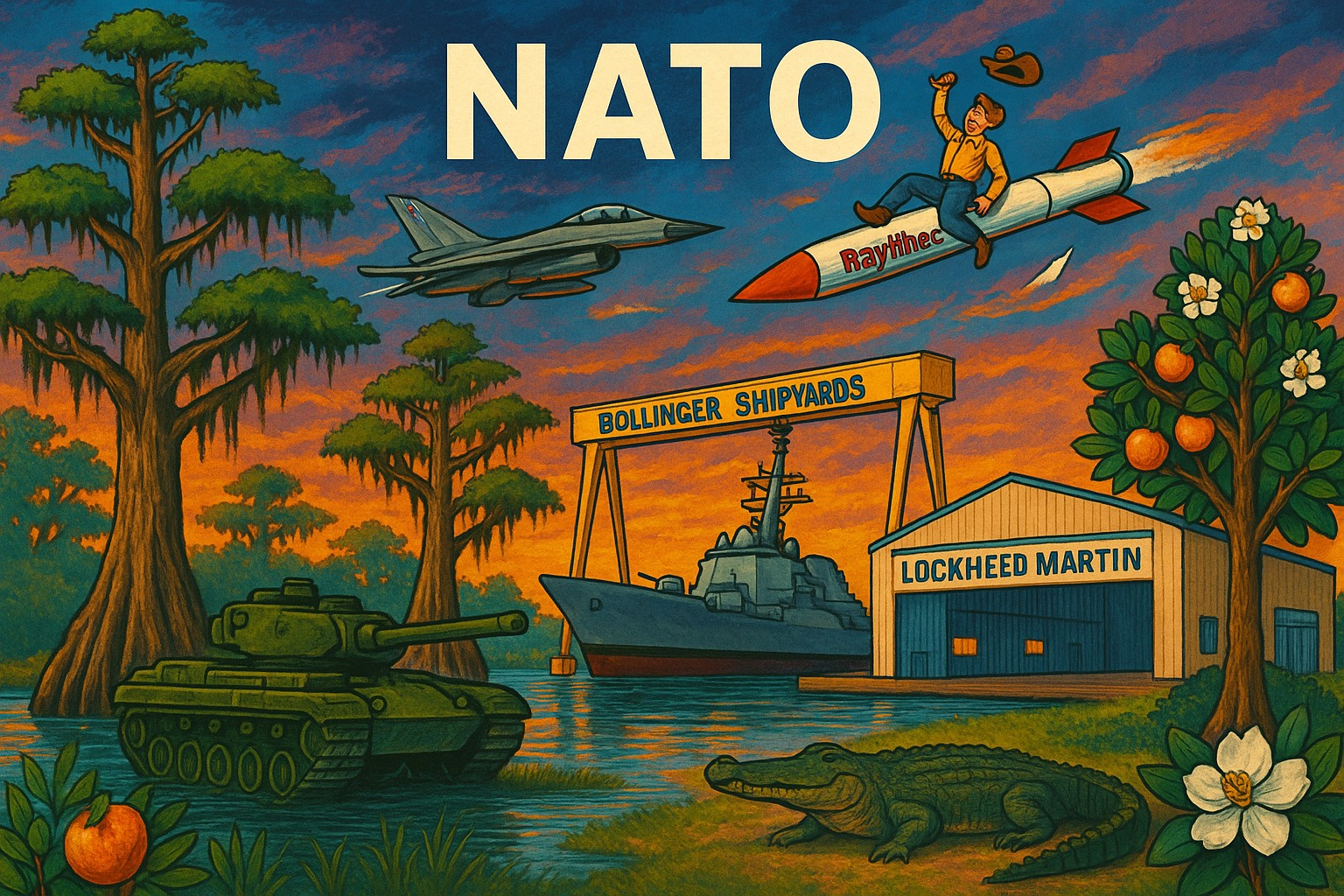
In a bold and unprecedented move, NATO announced last week that all member nations will increase defense spending to 5% of GDP by 2035 – more than doubling the alliance’s current 2% benchmark. This is a $1.2 trillion annual global defense commitment – and much of that investment will most likely pass through the American South. While this decision is rooted in rising global threats, it also sets off a powerful economic engine here at home, particularly across the Southern United States.
From Texas and Louisiana to Georgia, the Carolinas, and Florida, the South is uniquely positioned to power this new era of global defense production. Whether it’s shipbuilding in Louisiana, F-35 assembly in Texas, or cyber defense in Georgia, this policy could mark the beginning of a Southern-led military manufacturing resurgence.
Why the South Is NATO’s Industrial Launchpad
The Southern U.S. is already a backbone of American military and defense production. Consider:
- A deep concentration of military bases and logistics corridors (Fort Hood, Redstone Arsenal, Eglin AFB, Camp Shelby)
- Strong presence of prime defense contractors and thousands of suppliers (Lockheed Martin, Raytheon, Boeing, General Dynamics)
- Strong manufacturing bases in aerospace, shipbuilding, electronics, and specialty materials
- Strategic deepwater ports like New Orleans and Houston with transatlantic access
- A skilled, affordable workforce and pro-business infrastructure
As NATO nations begin modernizing their defense capabilities, they’ll look to this region for aircraft, ships, cybersecurity tools, components, and logistics support.
Breakdown: Regional Opportunities by Sector
1. Missiles, Fighters, and Advanced Systems (TX, AL, AR, AL)
- Lockheed Martin’s F-35 assembly line in Fort Worth, TX, is a key NATO asset. More NATO members are now expanding their fleets.
- Redstone Arsenal is a key US Army nad DoD installation in Huntsville, AL that is the main center for coordinting and approving NATO equipment sales
- Raytheon and Lockheed facilities in Arkansas and Alabama are major producers of missiles and radar systems (Patriot, THAAD, LRASM).
- With NATO allies seeking next-gen air and missile defense, production facilities in Texas and Arkansas are expected to scale rapidly.
2. Naval Shipbuilding (LA, MS, AL, FL)
- The Gulf Coast, from Mississippi to Florida, is the center of U.S. ship construction.
- Bollinger Shipyards, based in Lockport, LA, is a key supplier of Navy and Coast Guard vessels and has been expanding into NATO-adjacent programs.
- Ingalls Shipbuilding in Pascagoula, MS is the largest shipbuilder in the Southeastern U.S. and one of the largest private employers in Mississippi.
- Austral in Mobile, AL builds fast, modular vessels that are ideal for Baltic and Mediterranean navies operating in tight, contested and shallower waters
- Suppliers of marine electronics, propulsion systems, and structural components in the Southeast are also well-positioned to grow.
3. Cybersecurity and Command Infrastructure (GA, TX, FL)
- NATO has earmarked 1.5% of GDP for cyber, logistics, and industrial resilience.
- Atlanta and Austin are fast-growing tech hubs, specializing in cybersecurity, secure cloud services, and dual-use AI.
- As NATO allies harden their digital infrastructure, Southern tech firms will find new international markets and military clients.
4. Tier 2 & Tier 3 Manufacturing and Supply Chains (TN, AR, SC, NC, TX)
- Expect a supply chain explosion in parts manufacturing, coatings, electronics, and high-tolerance metalworking.
- Arkansas and Tennessee specialize in precision components, chemical production, and defense electronics.
- Texas, with its huge industrial base, is a vital supplier of everything from aircraft parts to mission-critical electronics.
Southern State-by-State Snapshot of Key Defense Roles
- TEXAS: F-35 production, drone systems, cyber defense, supply chain exports, and key Army/AF installations
- LOUISIANA: Port & logistic services, shipbuilding, chemical & fuel production, and heavy fabricators
- ARKANSAS: Missiles, radar, munitions components, electronics, and rural industrial manufacturing capacity
- ALABAMA: Missile systems, Redstone Arsenal, aerospace R&D, and shipbuilding
- FLORIDA: Naval bases, drone R&D, simulation, and international logistics
- Georgia: Cybersecurity, robotics, logistics hubs, and tech exports
- Mississippi: Naval fabrication and heavy industrial support for shipbuilding
- South Carolina: Composites, aircraft interiors, and advanced materials (especially via Boeing)
- Tennessee: Precision manufacturing, electronics, and materials suppliers
- North Carolina: Defense textiles, drone assembly, and systems integration hubs
Putting the 5 % of GDP and $1.2 Trillion Annual NATO Commitment Amount into Historical Context
1. Cold War U.S. Defense Spending (1950s–1980s)
- The U.S. frequently spent 6–9% of GDP on defense at the height of the Cold War.
- However, that was largely unilateral and wartime-oriented—NATO members were not held to a formalized shared spending goal above 2%.
- The Cold War saw higher spending but not as a coordinated alliance-wide commitment.
2. Post-9/11 U.S. Military Build-up (2001-2010)
- The U.S. launched massive expenditures post-9/11—wars in Iraq and Afghanistan cost $2–4 trillion for defense in total.
- Again, that was mostly reactive and U.S.-led—not a multilateral, decades-long industrial commitment.
3. The 2% NATO Target (2006–present)
- The current 2% GDP target was agreed in 2006 and reaffirmed in 2014, but few countries met it until recently.
- The 5% target reflects a doubling of commitment, and includes specific long-term industrial policy goals, not just military budgeting
What Makes the 5% NATO Pledge So Consequential?
- Collective Scale: 32 NATO countries coordinating to reach ~5% of GDP is unprecedented in peacetime.
- Long-Term Horizon: A 10-year roadmap to 2035 is rare—most defense surges are short-term.
- Industrial Investment: Unlike past pledges, 1.5% is dedicated to resilience, infrastructure, and industry—not just weapons.
- Geopolitical Timing: Comes amid rising threats from Russia, China, Iran, North Korea, and unstable regions.
- Private Sector Involvement: The focus on innovation, supply chain capacity, and public-private partnerships signals a new model of military readiness.
Final Thoughts on a Southern Surge for a Safer World
NATO’s 5% GDP defense pledge is not just about a deterrent military strategy. It’s a $1.2 trillion-per-year industrial mandate, and the American South is where much of it will be built. From the Port of New Orleans to Fort Worth’s F-35 line, and from Mississippi’s shipyards to Georgia’s cyber corridors, the South is preparing for the largest and longest-lasting defense manufacturing boom since World War II.
How The Goza Agency Helps Business Navigate the NATO Defense Boom
The coming surge in global defense spending will create unprecedented opportunity, but also complex challenges — especially for businesses looking to scale, insure, or partner internationally in the defense ecosystem.
That’s where The Goza Agency comes in – not just as an insurance advisor, but as a strategic partner helping businesses in the South secure the coverage, capital, and credit they need to grow confidently into the defense supply chain.
Here’s How The Goza Agency Can Help:
1. Insurance Built for Government and NATO-Aligned Work
Most companies underestimate how specialized their insurance needs become when working on defense-related or NATO-supported contracts. The Goza Agency helps businesses secure and manage:
- General and product liability tailored to defense contractors
- Inland marine and global cargo policies for shipping sensitive goods to NATO partners
- Cyber liability and Errors & Omissions (E&O) under DFARS/CMMC requirements
- Surety bonds and performance guarantees needed to win bids
Proper insurance is often a mandatory prerequisite for government and NATO subcontracts. Without it, you’re out of the running — regardless of capability.
2. Lending & Capital Readiness for Growth
Tapping into this defense-driven boom often means scaling up by expanding facilities, increasing production, or hiring specialized staff. But many businesses lack access to the right financing structures.
The Goza Agency works with lenders who understand government and NATO-aligned contracts, helping businesses secure:
- Working capital loans tied to contract award timelines
- Equipment financing for defense-rated machinery and vehicles
- Lines of credit for payroll, procurement, and rapid expansion
- Contract mobilization funding to get projects off the ground before first payment
These aren’t typical commercial loans — they require knowledge of the defense pipeline, contract structures, and federal compliance. The Goza Agency helps make those connections.
3. Capital Acquisition Strategy for Long-Term Positioning
If your business is preparing to expand for the NATO-driven manufacturing boom, The Goza Agency can help you grow smart – not risky.
The Goza Agency supports growth strategies that include:
- Partnering with private equity and infrastructure funds interested in defense
- Positioning businesses to attract federal infrastructure or defense-related grants
- Leveraging insurance-backed financial products to lower risk and unlock capital
Whether you’re trying to attract investors or secure SBA/DoD-backed loans, The Goza Agency helps you tell a credible, risk-aware story to capital providers.
From New Orleans to Mobile, Fort Worth to Fayeteville, The Goza Agency is here to make sure you’re protected, funded, and confident.

